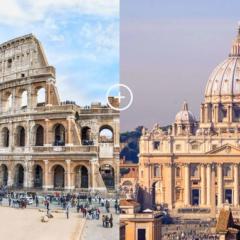
Vatican and Colosseum Tours in One Day: How to See Both
ByMario Dalo•March 26, 2026•Updated September 26, 2026
Founder & Research Analyst
📄Plan your Vatican and Colosseum tour in one day. Best tour options, visit order, skip-the-line tips, and how to get between both sites without wasting time.
💡 Quick Answer
You can visit the Vatican and the Colosseum in one day. Guided tours cover both sites in 6 to 8 hours, including the Colosseum, Roman Forum, Palatine Hill, Vatican Museums, and Sistine Chapel. Book timed-entry tickets at least 2 to 4 weeks ahead and allow 1 hour for travel between sites.
Can You Visit the Colosseum and the Vatican in One Day?
A typical one-day Vatican and Colosseum itinerary splits the day into two blocks. One block covers the Colosseum, Roman Forum, and Palatine Hill (roughly 2.5 to 3 hours). The other block covers the Vatican Museums, Sistine Chapel, and optionally St. Peter's Basilica (roughly 2.5 to 3.5 hours). Between the two blocks, you take a lunch break and travel across the city, which adds about 1 to 1.5 hours.
This format works well for most travelers. However, some visitors should consider spreading both sites across two separate days. If you want to spend significant time at the Roman Forum and Palatine Hill, explore the Vatican Museums beyond the highlights route, or climb the dome of St. Peter's Basilica, a single day will feel too tight. Families with young children, travelers with mobility concerns, and anyone visiting Rome during a summer heat wave should also weigh whether a packed full-day itinerary is the right call.
The key to making it work is advance booking. Both the Colosseum and the Vatican Museums require timed-entry tickets, and availability can disappear weeks ahead during peak season. Whether you book a guided tour or organize the day yourself, having confirmed time slots at both sites before you arrive in Rome removes the biggest source of stress.
How Many Hours Do You Need at Each Site
A realistic one-day plan requires a minimum of 6 hours of actual visit time, plus 1 to 1.5 hours for travel and lunch. Here is how the time breaks down at each site.
Colosseum, Roman Forum, and Palatine Hill
The Colosseum itself takes about 45 to 90 minutes, depending on whether you have standard access or add-ons like the arena floor or underground levels. The Roman Forum and Palatine Hill share the same archaeological park and require an additional 1 to 2 hours to walk through properly. If you are on a guided tour, expect to spend around 2.5 hours covering all three areas. If you are visiting independently and want to take your time at the Forum, budget closer to 3 hours.
Vatican Museums and Sistine Chapel
The Vatican Museums house over 7 kilometers of gallery corridors, but a guided highlights route typically takes 2 to 2.5 hours. This includes the key galleries — the Gallery of Maps, the Raphael Rooms, and the Sistine Chapel at the end. A self-guided visit with an audio guide can take anywhere from 1.5 hours (turbo pace) to 4 hours (deep visit). For a one-day itinerary paired with the Colosseum, plan on 2 to 2.5 hours inside the Museums.
St. Peter's Basilica: The Extra Time You Must Factor In
Many visitors assume St. Peter's Basilica is included in the Vatican Museums visit, but it is a separate site with its own entrance and security line. If you are on a guided tour that includes the Basilica, you can use the direct shortcut from the Sistine Chapel — a passage that bypasses the main security queue entirely. This saves significant time. Independent visitors must exit the Museums, walk around to St. Peter's Square, and wait in the public security line, which can add 30 to 60 minutes. Budget 45 to 90 minutes total for St. Peter's, including the wait. If you also want to climb the dome, add another 30 to 45 minutes on top of that.
Colosseum First or Vatican First? Best Order for Your Day
The best order depends on the season, the weather, and which site matters more to you. Both sequences work, but each has clear advantages.
Starting with the Colosseum in the Morning
This is usually the better choice from late spring through early fall. The Roman Forum and Palatine Hill are fully outdoors with almost no shade, and afternoon temperatures in July and August regularly exceed 35°C (95°F). Booking the earliest Colosseum entry (typically around 8:30 or 9:00) lets you walk through the Forum while the air is still cool. You finish by noon, take a proper lunch break, and head to the air-conditioned Vatican Museums for the afternoon.
This sequence also gives you more flexibility if something runs late in the morning. Vatican afternoon time slots tend to have wider availability than early-morning Colosseum entries, so there is more margin to adjust.
Starting with the Vatican in the Morning
This order makes sense in cooler months (November through March) or for travelers who prioritize art over archaeology. The Vatican Museums are visually and intellectually dense — the Sistine Chapel alone requires focused attention — so seeing them first uses your freshest mental energy on the most demanding site.
Some early-access Vatican tours start before the Museums open to the general public, which means smaller crowds and a quieter experience in the Sistine Chapel. If this option is available, it can be worth starting at the Vatican regardless of the season.
The downside is that an afternoon Colosseum visit in summer means arriving at the Forum and Palatine around 15:00–16:00, the hottest part of the day in the most exposed area. Multiple travel accounts describe this as exhausting.
The Season Rule of Thumb
In warm months (April to October), start with the Colosseum to keep the outdoor portion in the cooler morning hours. In cool months (November to March), either order works, but Vatican-first lets you enjoy the Museums with peak concentration. On any day, schedule your two time slots at least 4 hours apart to leave room for travel, lunch, and rest.
Best Colosseum and Vatican Tours
A guided tour is the most efficient way to visit both sites in a single day. The operator handles timed-entry tickets, sequencing, skip-the-line access, and navigation through each site, which removes the logistical complexity entirely.
Most full-day Vatican and Colosseum tours follow a similar structure: one site in the morning, a lunch break on your own, and the second site in the afternoon. Total duration runs between 6 and 8 hours depending on the operator and what is included.
When comparing tours, pay attention to these variables:
Feature Small-Group Tour Standard Group Tour Private Tour Group size 6–12 people 20–28 people Just your party Total duration 6–7 hours 5.5–7 hours 7–8 hours Includes St. Peter's Basilica Usually yes Varies Yes Includes arena floor Often yes Rarely Yes Transport between sites Sometimes Rarely Usually Skip-the-line at both sites Yes Yes Yes
Small-group and semi-private tours (6 to 12 people) offer a middle ground between price and experience. You get personalized attention from the guide, audio headsets so you can hear clearly, and access to features like the Sistine-to-Basilica shortcut. Standard group tours are more affordable but move faster and offer less interaction. Private tours are the most flexible but significantly more expensive.
Regardless of the format, confirm these details before booking: whether St. Peter's Basilica is included as a guided stop (not just "free time"), whether the tour provides transport between sites or you are on your own during the break, and whether children's pricing applies.
Small-Group (6–12)
Standard Group (20–28)
Private Tour
Duration
6–7 hours
5.5–7 hours
7–8 hours
Includes St. Peter's
Usually yes
Varies
Yes
Includes Arena Floor
Often
Rarely
Yes
Transport Between Sites
Sometimes
Rarely
Usually
Skip-the-Line
Yes
Yes
Yes
Guided Tour vs DIY Tickets: Cost, Flexibility and Stress
Both approaches work, but they suit different types of travelers. Here is how they compare on the factors that matter most.
Factor Guided Tour DIY (Self-Organized) Cost Higher — includes guide, tickets, logistics Lower — ticket prices only Planning effort Minimal — operator handles everything Significant — you manage two separate booking systems Flexibility Fixed schedule, set pace Full control over how long you stay Skip-the-line Pre-booked group entrance at both sites You still skip the ticket line with advance tickets, but wait in the same security line Sistine → Basilica shortcut Available on most guided tours Not available — you must exit and re-enter via St. Peter's Square Risk of missing a time slot Very low — guide manages timing Higher — transfer delays or underestimating distances can cause you to miss your entry window
The strongest argument for a guided tour is stress reduction. When both sites require timed entry and sit on opposite sides of Rome, having someone else manage the logistics means you simply show up and follow. Several travelers note that organizing the timing independently "is completely doable if everything is booked", but that the margin for error is small if anything runs late.
The strongest argument for DIY is freedom. If you want to spend an extra hour at the Roman Forum, linger in the Vatican's Gallery of Maps, or skip St. Peter's entirely, you can. A guided tour moves at a set pace and covers predetermined highlights.
For first-time visitors trying to see both sites in one day, a guided tour is usually the better choice. For repeat visitors or travelers with more flexible schedules, DIY gives you more control at a lower price.
How to Get Between the Colosseum and the Vatican
The Colosseum and the Vatican sit on opposite sides of central Rome, roughly 4.5 to 6 kilometers apart depending on your exact route. You have three main options for getting between them.
Guided Tour
DIY
Cost
Higher — includes guide, tickets, and logistics
Lower — ticket prices only
Planning Effort
Minimal — operator handles everything
Significant — two separate booking systems
Flexibility
Fixed schedule and pace
Full control over time at each site
Skip-the-Line
Group entrance at both sites
Skip ticket queue, same security line
Sistine → Basilica Shortcut
Available
Not available
Risk of Missing Time Slot
Very low
Higher if transfer runs late
Metro
Take Line B from Colosseo station to Termini, then switch to Line A toward Battistini and get off at Ottaviano (or Cipro). From Ottaviano station, it is a 10 to 12 minute walk to the Vatican Museums entrance on Viale Vaticano. Total travel time is about 25 to 35 minutes platform to door, though you need to add time for walking to and from metro stations. This is the cheapest option and the most predictable in terms of timing.
Taxi or Ride-Share
A taxi from St. Peter's Square to the Colosseum (or vice versa) takes about 10 to 15 minutes in favorable traffic. In heavy traffic, especially during weekday afternoons, it can stretch to 25 minutes. The fare runs approximately €10 to €15. This is the fastest and most comfortable option, particularly in summer heat or for travelers with mobility concerns.
Walking
The walk between the Vatican and the Colosseum takes roughly 50 to 60 minutes continuously through the historic center, passing through areas like Piazza Navona and Largo di Torre Argentina. It is a beautiful route but not practical if you have a fixed time slot at the next site, especially after spending hours on your feet inside museums and archaeological sites.
The Real Number to Plan With
Regardless of transport method, budget a full hour between finishing at one site and your timed entry at the other. This accounts for walking to the transport point, the journey itself, walking from the drop-off to the entrance, and the security check at arrival. Planning with this buffer prevents the most common problem travelers report: arriving late and stressed for their second time slot.
Tickets, Skip-the-Line and What You Need to Know Before You Go
Both the Colosseum and the Vatican Museums operate on timed-entry ticketing systems, and understanding how each one works is essential for planning a one-day visit.
Colosseum Tickets
All Colosseum tickets are nominative — they must include the full name of each visitor, matching a valid photo ID (passport or national ID card). Standard tickets cover the first and second tiers of the Colosseum plus access to the Roman Forum and Palatine Hill. Arena floor tickets and underground tickets are separate, premium options that sell out faster. Forum and Palatine access typically uses a broader entry window (often within 24 hours of your Colosseum slot), so you do not need to rush between sites inside the archaeological park. Book Colosseum tickets 2 to 4 weeks ahead in peak season; earlier if you want arena or underground access.
Vatican Museums Tickets
Vatican entry is also based on strictly timed tickets. The Museums open at 8:00 or 9:00 depending on the season, with the last entry typically at 14:30 (or 18:00 on Friday evening openings). Early-morning slots sell out first. You do not need a separate ticket for the Sistine Chapel — it is the final gallery on the Museums route. However, St. Peter's Basilica is free to enter and does not require a Vatican Museums ticket, though the security line can be long. Book Vatican tickets 4 to 6 weeks ahead during April through October.
What Skip-the-Line Actually Means
Skip-the-line tickets — whether purchased directly or through a tour — bypass the ticket office queue, not the mandatory security checkpoint. At both the Colosseum and the Vatican, every visitor passes through metal detectors regardless of ticket type. In peak season, the regular ticket-office line at the Vatican can reach 45 to 60 minutes, so pre-booked timed entry saves substantial time. At the Colosseum, security lines are generally shorter in the morning and grow longer in the afternoon.
Dress Code
The Vatican Museums, Sistine Chapel, and St. Peter's Basilica enforce a strict dress code: knees and shoulders must be covered for both men and women. Sleeveless tops, shorts above the knee, and hats inside the Basilica are not permitted. Visitors who do not comply are denied entry with no exceptions. The Colosseum has no formal dress code, but comfortable closed-toe shoes are strongly recommended due to uneven stone surfaces at the Forum and Palatine Hill.
Bag Policy
The Colosseum does not allow large backpacks, trolleys, or glass bottles, and there is no cloakroom available. The Vatican Museums have a cloakroom but restrict items larger than 40 × 35 × 15 cm. Travel light — a small crossbody bag or daypack is ideal for both sites.
Practical Tips for Your Colosseum and Vatican Day
What to Wear and Bring
Wear comfortable walking shoes with good support — you will be on your feet for 6 to 8 hours on stone, cobblestone, and uneven terrain. Dress to meet the Vatican dress code (covered shoulders and knees) even if you are visiting the Colosseum first, so you do not need to change between sites. Bring a refillable water bottle (Rome has free drinking fountains throughout the city), sunscreen in summer, and a valid photo ID for Colosseum entry.
Where to Eat Between Sites
Use the lunch break between your two visits to eat properly and rest your legs. If you finish at the Colosseum in the morning and are heading to the Vatican, the Prati neighborhood near the Vatican has a wide range of restaurants and is much less touristy than the streets immediately around St. Peter's Square. If you finish at the Vatican first, the Monti neighborhood near the Colosseum offers excellent Roman trattorias at fair prices. Avoid eating directly at either site's entrance — the quality drops and prices rise significantly within the closest 100 meters.
Time Buffers and Pacing
Never schedule your two time slots back-to-back. Leave at least a 4-hour gap between bookings to account for the tour itself running slightly over, the transfer, lunch, and arrival at the second site with time for security. If your Colosseum entry is at 9:00, do not book the Vatican before 13:00 at the earliest.
The Most Common Mistake
The most common mistake on a Vatican and Colosseum day is trying to add too much. One-day itineraries that include the Colosseum, Vatican, Trevi Fountain, Pantheon, and Piazza Navona in the same day are physically possible but leave almost no dwell time at any site. You end up walking past things instead of experiencing them. If you want to genuinely see both the Colosseum and the Vatican, focus exclusively on those two sites and save Rome's piazzas and fountains for a separate day or evening stroll.
Common questions
❓ Can You Visit the Colosseum and the Vatican in One Day?
A typical one-day itinerary splits into two blocks: 2.5 to 3 hours at the Colosseum, Roman Forum, and Palatine Hill, and 2.5 to 3.5 hours at the Vatican Museums and Sistine Chapel, with a lunch break and 1-hour transfer in between.
❓ Colosseum First or Vatican First?
In warm months (April to October), start with the Colosseum to keep the outdoor portion in the cooler morning hours. In cool months, either order works, but Vatican-first lets you experience the Museums with peak energy and concentration
❓ How to Get Between the Colosseum and the Vatican?
The two sites sit 4.5 to 6 km apart. A taxi takes 10 to 15 minutes, the metro 25 to 35 minutes with one line change at Termini. Budget a full hour door-to-door to account for walking, waiting, and security at arrival.
❓ Should I visit the Colosseum or the Vatican first?
In warm months (April to October), visit the Colosseum first to avoid afternoon heat at the Roman Forum and Palatine Hill. In cooler months, either order works well.
❓ How long does a Colosseum and Vatican tour take?
A full-day tour typically takes 6 to 8 hours. The Colosseum block runs about 2.5 to 3 hours and the Vatican block about 2.5 to 3.5 hours, plus travel and lunch in between.
❓ How do you get from the Colosseum to the Vatican?
The fastest way is by taxi, which takes 10 to 15 minutes. By metro, the trip takes 25 to 35 minutes with one line change at Termini station. Budget a full hour door-to-door to account for walking and security.
❓ Do you need skip-the-line tickets for the Colosseum and Vatican?
Skip-the-line tickets are strongly recommended at both sites. In peak season, the regular ticket queue at the Vatican alone can reach 45 to 60 minutes. Pre-booked timed entry bypasses the ticket line but not the mandatory security checkpoint.
❓ What is the dress code for the Vatican?
Knees and shoulders must be covered for both men and women. Sleeveless tops, shorts above the knee, and hats inside the Basilica are not permitted. Visitors who do not comply are denied entry with no exceptions.
❓ Do you need a passport to enter the Colosseum?
Yes, all Colosseum tickets are nominative and require a valid photo ID — passport or national ID card — matching the name on the ticket. Visitors without proper identification are denied entry.
About the Author
Mario Dalo
Founder & Research Analyst
I founded ColosseumRoman to apply the method we use across the Intercoper portfolio: read what thousands of travelers actually reported, verify what can be verified, and publish what the evidence supports — including the parts that don't help a booking.