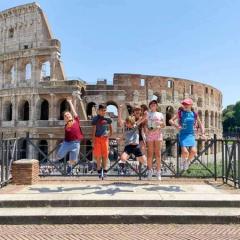
📄Visiting the Colosseum with kids? Age-by-age guide (babies to teens), stroller policy, family tours, tower rules, and practical tips for a stress-free visit.
💡Quick Answer
The Colosseum works well with school-age kids and teens but is challenging with babies and toddlers due to heat, crowds, and stairs. Children under 18 enter free (valid ID required). Small foldable strollers are allowed on the main levels but not underground. The sweet spot for family tours is ages 8–12 with a kid-focused private or small-group tour of 2 to 3 hours. Book early-morning slots and plan a gelato break immediately after to avoid post-Colosseum meltdowns.
Is the Colosseum Really Kid-Friendly?
The Colosseum can be genuinely thrilling for children — gladiator stories, wild animal tales, the sheer scale of the arena, and the engineering of the underground tunnels all connect with kids in ways that many art museums cannot. But "kid-friendly" depends heavily on age, weather, and how much structure the adults provide.
The positives are real: the building is dramatic and immediately impressive, the stories are action-packed (fights, lions, emperors, betrayal), and children under 18 enter free on official tickets. The challenges are equally real: summer heat is brutal (the arena is fully exposed), the Forum and Palatine Hill involve rough terrain and long walks, security lines can test any child's patience, and the underground tunnels are tight, dim, and not suitable for very young children or anyone afraid of enclosed spaces.
The rules families need to know:
Children under 18 enter free (all nationalities) but must have their own ticket with a valid photo ID scanned at entry. Children under 12 must be accompanied by an adult at all times. Running, climbing barriers, and leaning over railings are strictly forbidden — staff will intervene. Large backpacks and suitcases are not allowed, and there is no on-site luggage storage. Security screening is airport-style with metal detectors.
The families who report the best Colosseum experiences share one trait: they matched the visit to their kids' age and energy, kept it under 2 to 3 hours, and had a clear reward planned for afterward.
Age-by-Age Guide: What Works at Every Stage
The single biggest factor in whether kids enjoy the Colosseum is matching the visit to their developmental stage — not the ticket type or time of day.
Age Group
Realistic Time
Best Approach
Underground OK?
Arena Floor?
0–3 years
1–1.5 hours
Carrier, Colosseum only, skip Forum if tired
No
No
4–7 years
1.5–2 hours
Treasure hunt, short family tour, save Forum for later
Not recommended
Yes (great impact)
8–12 years
2–3 hours
Kid-oriented tour with activities, Colosseum + Forum
Yes (ages 8+)
Yes (highlight)
13–17 years
2.5–3 hours
Full guided tour, give them a role, deeper stories
Yes
Yes
Babies and Toddlers (0–3 years)
At this age, the focus is logistics, not history. Use a front carrier instead of a large stroller — the Forum and Palatine Hill have rough surfaces, stairs, and narrow paths where a stroller becomes a burden. Keep the visit to 1 to 1.5 hours maximum, covering only the Colosseum interior (skip the Forum if energy is low). Book the earliest slot to avoid midday heat, bring sun protection and water, and have an exit plan ready. Nap schedules, feeding, and shade matter more than gladiator stories at this age.
Young Kids (4–7 years)
Children this age can enjoy stories about gladiators, animals, and emperors, but attention spans are short and heat tolerance is limited. Turn the visit into a game: count the arches (there are 80 on each level), look for animal carvings, imagine what the arena looked like full of water for naval battles. Keep the total visit to about 2 hours. A short family-oriented private or semi-private tour works well at this age — but avoid hardcore underground tours or full-day combos. Save the Forum and Palatine for a separate outing if the kids are fading.
Older Kids and Tweens (8–12 years)
This is the sweet spot for the Colosseum. Children in this range understand narratives, can walk for longer, and ask real questions about how the games worked, why gladiators fought, and how the elevators brought animals up through trapdoors. Two-to-three-hour kid-oriented tours that combine the Colosseum and Forum with activity booklets, role-play, and questions work brilliantly. The best family tours end with a gelato stop — reviewed consistently as the detail that makes the whole day land. Arena floor access is particularly impactful for this age group.
Teenagers (13–17 years)
Teens can handle adult-level content but may be bored by slow group pacing. They respond better to intense stories — the engineering behind the hypogeum, the politics of the gladiatorial games, the myths versus reality of what actually happened in the arena. Give them a role: photographer, fact-checker, navigator. A strong general Colosseum + Forum guided tour works well, or a private family tour where teens can ask specific questions and move at their own pace. Set clear expectations about heat, water, phone use, and the fact that the Forum involves serious walking on uneven terrain.
Stroller Policy, Underground Rules, and Accessibility
Strollers: Small, foldable strollers are allowed on the Colosseum's main levels (ground floor and first tier), which have elevators and ramps. However, the underground tunnels, upper tiers, and large sections of the Roman Forum and Palatine Hill involve stairs, uneven stone surfaces, and narrow paths where a stroller becomes impractical. Many family guides recommend a compact umbrella stroller for the Colosseum interior plus a front baby carrier for the Forum — switching between the two as terrain changes.
Important: Some guided tours do not follow the accessible route and cannot accommodate strollers. Always check the operator's policy before booking a family tour with a stroller.
Underground with kids: Children under 6 are generally not recommended for the underground due to tight corridors, dim lighting, uneven floors, and limited space to maneuver. There is no official age minimum for the hypogeum on the standard Full Experience ticket, but guided tour operators often set their own minimum at age 6 or 8. The arena floor is a better option for younger children — it is open-air, visually dramatic, and does not involve enclosed spaces.
Wheelchair and mobility accessibility: The Colosseum's main levels are wheelchair accessible with elevators and ramps. The underground, arena floor, and upper tiers are not accessible for wheelchairs, strollers, or visitors with significant mobility impairments. Contact the archaeological park in advance to arrange specific accommodations.
Best Colosseum Tours for Families (By Age and Budget)
The right tour depends on your children's ages and how much you are willing to spend.
Option
Price
Group Size
Duration
Best Ages
Private kid-specialist tour
€150–€300/group
Your family only
2–2.5 hours
6–14
Small-group family tour
€45–€70/person
10–15 people
2.5–3 hours
6–17
Standard guided tour
€40–€50/person
15–25 people
2.5–3 hours
10+ (not kid-specific)
Self-guided (official ticket)
€18/adult, free under 18
Individual
At your pace
Any — with parental structure
High-budget families (private kid-specialist tours, €150–€300/group): Companies like Kids Raphael Tours, LivTours, and Joy of Rome offer private family tours specifically designed for ages 6 to 14. These include skip-the-line entry, a guide trained to engage children, activity booklets or scavenger hunts, flexible pacing, and often extras like a gelato stop or a gladiator-themed storytelling segment. Duration is typically 2 to 2.5 hours covering Colosseum + Forum. This is the format with the highest satisfaction ratings from families.
Mid-budget families (small-group family tours, €45–€70/person): Small-group tours that cap the group at 10 to 15 people and advertise "family-friendly" guides offer a significant upgrade over generic 25-person tours. They include skip-the-line entry, headsets, and a structured route, with guides who adjust pacing for mixed-age groups. Arena floor access is sometimes included at the upper end of this range.
Budget-conscious families (self-guided, €18/adult, free for under-18s): The official €18 ticket plus the free audio app gives you maximum flexibility — stop when the kids want to look at something, leave when energy drops, and set your own pace entirely. This works best for families with confident, independent parents who have done some reading in advance. Pair it with a printed or downloaded kid-friendly activity sheet to give the visit structure.
For all ages: Book the earliest available slot (8:30 or 9:00 a.m.) for cooler temperatures and lighter crowds. Avoid the 10:30 a.m.–2:00 p.m. peak entirely with children. Wednesday and Thursday mornings tend to be the calmest weekdays.
Practical Tips: Heat, Bathrooms, Bags, and the Post-Colosseum Plan
The logistics that make or break a family Colosseum visit happen before and after the building, not inside it.
Heat management: The Colosseum and Forum are almost entirely outdoor, with minimal shade. In June through September, midday temperatures regularly exceed 30°C (86°F), and the stone radiates heat. Bring hats, sunscreen, and at least one water bottle per person (refillable — Rome has free drinking fountains). Book early-morning or late-afternoon slots in summer. A child who is overheated and dehydrated in the Forum at 2:00 p.m. in August will not enjoy anything.
Bathrooms: Use them before security. There are restrooms inside the Colosseum, but the lines can be long during peak hours. For very young children, a preventive stop before entering is non-negotiable.
Bags: Only small daypacks and handbags are allowed. No large backpacks, suitcases, or glass bottles. Pack light — a small crossbody bag with water, snacks, sunscreen, and a hat covers everything a family needs.
Food: Eating inside the Colosseum is not allowed. Feed the kids before entering. Bring sealed snacks (granola bars, crackers) for the Forum walk, where the visit can stretch longer than expected. Avoid the overpriced restaurants directly adjacent to the Colosseum — walk two blocks in any direction for better food at lower prices.
The post-Colosseum plan: This is the detail that separates a good family day from a meltdown. Do NOT schedule another intense attraction immediately after the Colosseum. Kids need 30 to 60 minutes of unstructured time — a gelato stop, a playground, a park bench in the shade. The park behind the Basilica of Maxentius, the gardens on Palatine Hill, or simply a café on a side street all work. Make the deal before you go in: "We're going to see the Colosseum, and then gelato."
Preparing kids before the visit: Show them 3 to 4 photos or a short video of gladiator scenes and the arena. Explain that the Colosseum is a very old, very big arena where people used to watch fights — like a sports stadium from 2,000 years ago. Give each child a mission: count the arches, find the strongest-looking column, spot where the animals came up through the floor. A child with a mission engages. A child without one asks "when are we leaving?" within five minutes.
Common questions
❓ Is the Colosseum good for kids?
Yes, for school-age children and teens — the gladiator stories, engineering, and dramatic scale connect well with kids. It is more challenging with babies and toddlers due to heat, crowds, and stairs. Children under 18 enter free (ID required). Plan 2 to 3 hours total, book an early-morning slot, and schedule a gelato break immediately after.
❓ Are strollers allowed in the Colosseum?
Small, foldable strollers are allowed on the main levels (ground floor and first tier), which have elevators and ramps. However, the underground, upper tiers, and most of the Roman Forum involve stairs and rough terrain where strollers are impractical. A compact stroller plus a front carrier as backup is the safest combination for families.
❓ How should I prepare my kids for visiting the Colosseum?
Show them a few photos of gladiators and the arena, explain it as "a sports stadium from 2,000 years ago," and give each child a simple mission — count arches, spot animal carvings, or imagine what the arena looked like full of water. Book the earliest slot, bring water and sun protection, and plan a gelato stop immediately after.
❓ Is the Colosseum free for children?
Yes, visitors under 18 of all nationalities enter free. A valid photo ID is required at the entrance. EU citizens aged 18–25 pay a reduced rate of €2. Free entry still requires a timed-entry ticket — book at colosseo.it.
❓ Can kids go into the Colosseum underground?
There is no official age minimum on the Full Experience ticket, but the underground involves tight corridors, dim lighting, and uneven floors. Most guided tour operators set a minimum age of 6 to 8 years. The arena floor is a better option for younger children — open-air, visually dramatic, and no enclosed spaces.
❓ What is the best Colosseum tour for families?
For children 6 to 14, a private kid-specialist tour (€150–€300 per group) with scavenger hunts, storytelling, and flexible pacing delivers the highest satisfaction. For mid-budget families, small-group tours (€45–€70 per person) with family-friendly guides and groups of 10 to 15 are a strong alternative.
❓ How long should I spend at the Colosseum with kids?
Most children stay engaged for 1.5 to 2.5 hours depending on age. Budget 2 to 3 hours total including security, the visit, and exterior photos. Do not schedule another intense attraction immediately after — plan a gelato stop or park time for decompression.
❓ What is the best time to visit the Colosseum with kids?
Early morning (8:30–9:30 a.m.) for cooler temperatures and lighter crowds. Avoid 10:30 a.m. to 2:00 p.m. entirely with children — the combination of peak heat and peak crowds is the fastest path to a meltdown. Wednesday and Thursday mornings are the calmest weekdays.
Our team analyzes what travelers publicly reported about each tour — thousands of reviews, forum threads and questions — and verifies what can be verified against operators and official sources. We publish what the evidence supports, including the parts that argue against a booking.