Colosseum Opening Hours and Best Time to Visit in 2026
ByMario Dalo•March 18, 2026•Updated September 26, 2026
Founder & Research Analyst
📄Colosseum opening hours 2026 by season, best time of day and month to visit, free entry days, and how long you need. Updated schedule with closing times and last entry
💡 Quick Answer
The Colosseum opens daily at 8:30 AM year-round, with closing times ranging from 4:30 PM in winter to 7:15 PM in summer. Last entry is always 1 hour before closing. The least crowded times are right at opening (8:30–9:30 AM) and the final hours before closing. The best months to visit are October, November, February, and March. The Colosseum is closed on December 25 and January 1.
🕐 Colosseum Opening Hours 2026
Period
Opens
Closes
Last Entry
Jan 2 – mid March
8:30 AM
4:30 PM
3:30 PM
Mid March – last Sat of March
8:30 AM
5:30 PM
4:30 PM
Last Sun of March – Sep 30
8:30 AM
7:00–7:15 PM
6:00–6:15 PM
Oct 1 – last Sat of October
8:30 AM
6:00–6:30 PM
5:00–5:30 PM
Last Sun of Oct – Dec 31
8:30 AM
4:30 PM
3:30 PM
Colosseum opening hours by season in 2026
In 2026 the Colosseum opens every day at 8:30 am, with closing times changing throughout the year. Last entry is always 1 hour before closing, regardless of the season.
From 2 January to around mid-March, the Colosseum typically runs on a winter schedule of 8:30 am to 4:30 pm, with last entry at 3:30 pm. From mid-March until the last Saturday of March, closing is extended to around 5:30 pm, giving visitors an extra hour in the late afternoon as daylight increases.
From the last Sunday in March through 30 September, the Colosseum follows its longest schedule of the year, remaining open until about 7:00–7:15 pm, with last entry around 6:00–6:15 pm. This period covers spring, summer and early autumn, when demand is highest and daylight hours are longest.
From 1 October to the last Saturday of October, closing time steps down slightly to around 6:00–6:30 pm, still allowing for late-afternoon visits but with shorter daylight compared to summer.
From the last Sunday of October through 31 December, the Colosseum returns to its winter schedule of 8:30 am to 4:30 pm, with last entry at 3:30 pm. The monument is closed on December 25 and January 1.
Roman Forum and Palatine Hill opening hours
The Roman Forum and Palatine Hill follow a very similar seasonal pattern to the Colosseum, but generally open at 9:00 am instead of 8:30 am. Closing times and last entry rules are aligned, with last access always 1 hour before closing.
Between late October and late March, opening hours are typically 9:00 am to 4:30 pm. From late March to the end of September, hours extend to around 9:00 am to 7:00–7:15 pm, matching the longer Colosseum schedule.
In early October, closing shifts gradually to around 6:30 pm before returning to the winter timetable later in the month.
Because all three sites are included in the same ticket, many visitors begin at the Colosseum for the first time slot and then continue to the Forum and Palatine once they open at 9:00 am. It’s always worth checking the exact times on your ticket or the official Parco Archeologico del Colosseo website before your visit, as occasional changes can occur.
When is the Colosseum least crowded?
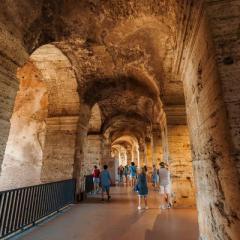
The Colosseum is least crowded right at opening (around 8:30–9:30 am) and again in the final hours before closing, especially outside peak summer.
Arriving early gives you the smoothest entry through security and noticeably more space inside. Late afternoon is the second best option, when many group tours finish and day visitors begin to leave. In summer, this window usually starts around 4:00 pm; in winter, it begins earlier due to shorter opening hours.
The busiest period is late morning to mid-afternoon, roughly between 11:00 am and 3:00 pm, when both crowds and temperatures peak.
Mid-week days such as Tuesday, Wednesday and Thursday tend to be slightly quieter than weekends and Mondays. Fridays through Sundays are consistently busy year-round, and holiday periods like Easter or Christmas bring peak-level crowds regardless of the day.
On the first Sunday of each month, when entry is free, the Colosseum is extremely crowded from early morning, with long queues forming before opening. If your goal is to avoid crowds, it is best to skip these dates.
Best months to visit the Colosseum
The best months to visit the Colosseum in 2026 are generally October, November, February and March, when temperatures are milder and crowds are lighter.
Spring, especially March and early April, offers a good balance between weather and visitor numbers, although Easter can bring a temporary spike in crowds. May has excellent weather but already feels like early peak season, so early or late time slots are recommended.
Summer, from June to August, is the busiest and hottest period of the year, with temperatures often exceeding 30–35°C. If you visit during these months, early morning or late afternoon slots are essential, and you should plan for slower movement and longer security lines.
Autumn is one of the most enjoyable times to visit. September remains busy but eases toward the end of the month, while October combines comfortable temperatures with significantly fewer visitors. November can be particularly quiet, though weather becomes less predictable.
Winter, from December through February, offers the lowest crowd levels and the best chance of last-minute availability. However, shorter days and cooler, sometimes rainy weather should be taken into account.
📅 Best Months to Visit the Colosseum
Month
Crowds
Temperature
Recommendation
Jan–Feb
Very low
5–12°C
Best for no crowds, dress warm
Mar–Apr
Medium
12–20°C
Best balance weather/crowds
May
Medium-high
18–25°C
Book early morning slots
Jun–Aug
Very high
28–35°C
Avoid midday, early or late only
Sep
High
22–28°C
Eases late month
Oct
Low-medium
15–22°C
Best overall month
Nov
Low
10–16°C
Quiet, weather variable
Dec
Very low
5–12°C
Shortest hours, least crowds
Colosseum free entry days: first Sunday of the month
The Colosseum offers free entry on the first Sunday of every month, along with selected national holidays, but these days come with significant trade-offs.
On free Sundays, entry to the Colosseum, Roman Forum and Palatine Hill is granted on a first-come, first-served basis. There is no advance booking, and queues often form well before opening. Waiting times can be long throughout the morning, and access is limited to standard areas, with sections like the underground or arena floor usually excluded.
Additional free-entry days may occur on national holidays such as April 25, June 2 and November 4. Certain visitor categories, including under-18s and people with disabilities, may also qualify for free or reduced entry on regular days, although a ticket is still required.
Free days are best suited to visitors on a strict budget who are willing to trade time and comfort for savings. For a smoother experience, access to restricted areas or guided tours, a regular paid ticket is usually the better option.
How long does a Colosseum visit take?
A visit to the Colosseum alone typically takes around 1.5 to 2 hours, while a full visit including the Roman Forum and Palatine Hill usually requires at least 3 to 4 hours in total.
For a standard self-guided visit of the Colosseum, including the main levels and viewpoints, 60 to 90 minutes is generally sufficient. If your ticket includes additional areas such as the arena floor, upper tiers or underground sections, you should allow closer to 2 hours inside the monument.
The Roman Forum and Palatine Hill together usually take between 1.5 and 2.5 hours, depending on how deeply you explore the ruins and viewpoints. Combined with the Colosseum, a comfortable plan is to set aside at least half a day.
Guided tours that include all three sites typically last around 2.5 to 3 hours, offering a structured experience but less flexibility. Self-guided visits allow you to move at your own pace, though it’s important to factor in time for security checks, breaks and navigation between areas.
Common questions
❓ What time does the Colosseum open and close in 2026?
The Colosseum opens at 8:30 AM every day year-round. Closing time varies by season: 4:30 PM in winter (November–March), 7:00–7:15 PM in summer (late March–September), and transitional hours in between. Last entry is always 1 hour before closing.
❓ What is the least crowded time to visit the Colosseum?
The Colosseum is quietest right at opening between 8:30 and 9:30 AM and again in the final hours before closing, especially on Tuesdays, Wednesdays, and Thursdays. The busiest period is 11:00 AM to 3:00 PM year-round.
❓ How many hours do you need at the Colosseum?
The Colosseum alone takes 1.5 to 2 hours for a standard visit. Adding the Roman Forum and Palatine Hill brings the total to 3–4 hours. Guided tours covering all three sites typically last 2.5 to 3 hour
❓ Is the Colosseum open every day?
Yes, the Colosseum is open every day of the year except December 25 and January 1. Hours vary by season, with the longest schedule running from late March through September.
❓ Is the Colosseum free on the first Sunday of the month?
Yes, entry to the Colosseum, Roman Forum, and Palatine Hill is free on the first Sunday of every month. However, there is no advance booking, queues form well before opening, and access is limited to standard areas only.
❓ What is the best day of the week to visit the Colosseum?
Tuesday, Wednesday, and Thursday are typically the quietest days. Weekends and Mondays tend to be busier, and the first Sunday of each month is extremely crowded due to free entry.
❓ Can you enter the Colosseum after the last entry time?
No, once the last entry time has passed you cannot enter the monument. If you arrive late, entry may be refused even with a valid ticket. Always arrive 15–30 minutes before your time slot.
❓ Do the Roman Forum and Palatine Hill have the same hours as the Colosseum?
Almost. The Forum and Palatine Hill open at 9:00 AM instead of 8:30 AM, but closing times and last entry rules are the same. All three sites are included in the same ticket
I founded ColosseumRoman to apply the method we use across the Intercoper portfolio: read what thousands of travelers actually reported, verify what can be verified, and publish what the evidence supports — including the parts that don't help a booking.



 Roman Forum - Palatine Guided Tour $55
 Colosseum Arena Twilight Tour and Roman Forum$100
 Three Sites Colosseum Forum Palatine Guided Tour$44